THE DIRECTION WE CHOOSE
How do we carry
this experience forward?
Experiencing can feel good or bad
Pull and push arise within it
Facts alone do not give us a direction
Knowing the world
does not tell us how to live
The fact that experiencing occurs does not by itself set a direction for life. Even if we understand how the world works, we still have to consider how to live.
I do not think good and evil exist independently of human judgment and experience. Yet experiencing can clearly feel good or bad.
Some experiences feel good; others feel unpleasant. We want certain things and avoid others. Pull and push arise within experiencing.

Pull and push
We feel pulled toward what we want and pushed away from what we do not want. Their directions change with sensation, memory, belief and expectation.
How wanting and choosing take shape connects back to what's discussion of response and choice.
Norms remain a question even without objective good and evil
Living together brings different experiences into contact and sometimes conflict. We can examine how a norm changes those experiences.
Feeling good and wanting are different
Getting what we wanted
can still feel empty
Wanting something and experiencing it as good are not the same. We may feel empty after getting something we longed for, or find unexpected music beautiful.
Suppose someone restrains me and injects a drug that makes me feel good. I did not want it, yet that moment might feel good. The quality of experiencing is distinct from whether I consented to it or chose it myself.
What wanting tells us
Wanting can lead to actions that produce bad experiences. We need to look at both what was wanted and what was actually experienced.
Wanting and not wanting give pull and push their directions. Feeling good or bad describes the quality of experiencing itself. They often coincide, but sometimes diverge.
The target
We always aim,
but we do not always hit
Wanting aims at a good experience. Pull and push also move in relation to that target.
We may get what we wanted and still feel bad. There can be a gap between what we aimed for and what we actually experienced.
Suppose the drug has no side effects and causes no future loss. I would judge it by how it is actually experienced. My initial refusal included an expectation that it would feel bad.
EQQ
Experience Quality and Quantity
ExperienceQUALITY
Quality · How good or badQUANTITY
Quantity · How long and how much
Quality is how good or bad something feels. Quantity is how long or how much that experiencing continues.
Quantity itself has no positive or negative sign. More good experiencing is better; more bad experiencing is worse. Experiences yet to come remain possibilities.
EQQ is a translator, not an answer sheet. It lets us ask what love, freedom, money and art do to the quality and quantity of experience in a common language.
Translating into a common language
Art: Art changes the quality of experiencing through wonder, beauty, comfort and memory. For me, its value lies in those experiences.
Love: Love lets another being's joy and pain enter deeply into my own experience. It widens the range of what can feel both good and bad.
Freedom: Freedom increases the possibilities of moving toward desired states and away from unwanted ones. Those possibilities may be experienced well or badly.
Money: Money changes the range of experiences available and the control one has over them. More money does not always produce proportionately better experiences.
Health: Health reduces pain and preserves possibilities for future experiencing. Maintaining biological function and continuing to experience something good are distinct matters.
Comparing quality and quantity
How should we compare a large improvement for one person with smaller improvements for many, the present with the future, or extreme suffering with other experiences? EQQ provides a language for making these judgments clearer.
Life, health, freedom and time leave room for future experiences, good and bad. How to assess choices that close those possibilities can be explored separately.
Each person's judgment
Everyone is already
aiming at a target of their own
Each person's judgments take their own EQQ as a reference. Even without knowing the term EQQ, our choices already involve how we expect things to be experienced.
Choices do not always improve EQQ. In addiction, relief from an immediate craving can pull harder than the cost of the distant future. Predictions fail, and impulses take the lead.
Sacrificing for someone else is not outside this picture. Living with the knowledge that one abandoned a loved one may feel worse than the personal cost of helping. Being aware of the target sharpens the resolution of judgment.
How choices take shape
To understand a choice, we can examine what was anticipated and feared beforehand. Memory, disposition, belief and environment help shape it.
Understanding how choices form can also help us decide what to choose next.
Beyond myself
What appears to me
enters my experience
Other beings and events also enter my experience: people, animals, objects, even fictional characters. How they appear to me, and how I respond, affects my present EQQ.
If another being truly suffers, that pain belongs to its own experience. I can respond by knowing about it, imagining it and caring. That response also affects my experience.
My future self's experience is not directly present now. How much I care about that future becomes part of my present judgment.
The hypothesis of capacity
Does responsiveness to my distant future self grow alongside responsiveness to more other experiencers? Whether something that expands both could be called one's “capacity” is a hypothesis for Aquarium Lab to investigate.
A loved one's joy becomes my joy; their suffering can undo my whole day. This idea of capacity asks how far and how widely that overlap extends.
The unit of judgment
The scope changes
with the question
- Me
- People close to me
- Citizens
- Humanity
- Cows · pigs · chickens
- JellyfishIf they experience anything
- AIIf they experience anything
- Superintelligent AIIf it does not experience anything
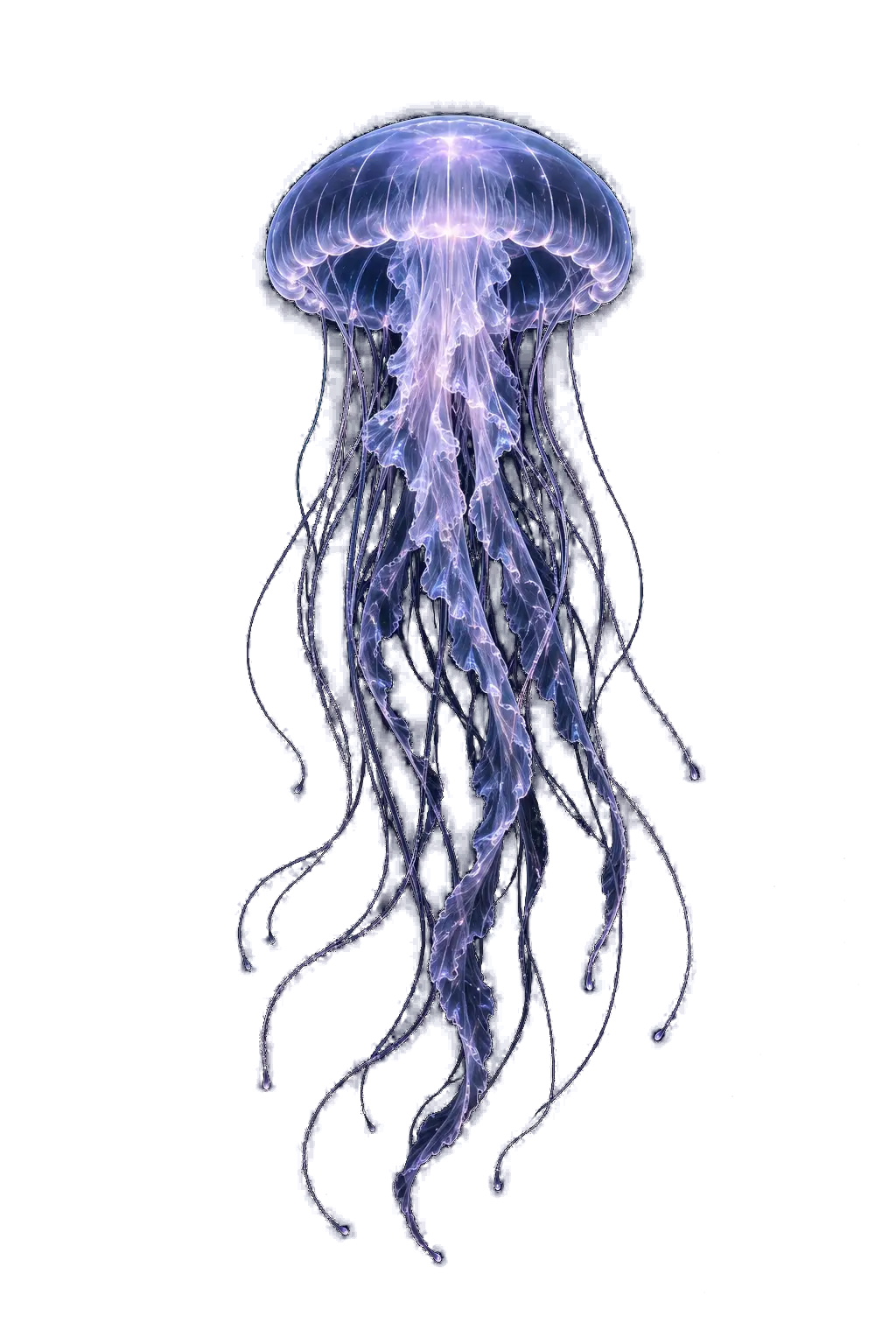
For a question with a defined unit, that unit's EQQ is the reference. Individuals judge by their own EQQ, a country by the EQQ of those who make it up, and humanity by human EQQ. Other beings enter insofar as they affect how people within that unit experience things.
When asking “Is this norm itself good?”, I consider the EQQ of every experiencer affected by it.
The suffering of cows, pigs and chickens matters too. If jellyfish experience anything, their experiences count. The same holds for AI, if it experiences anything. What matters is whether anything is actually experienced.
Law, morality and leadership
I see law and morality as ways of organizing a world in which experiences can conflict. Rewards and punishments, trust and responsibility, contracts and rules all enter the picture.
I evaluate leaders by how well they preserve and improve the experiences of the group they serve. To evaluate the norm itself, however, I widen the view to every experiencer it affects.
How to weigh different experiencers' EQQ, severe suffering, distribution, uncertainty and future experiencers deserves separate consideration.
Resolution
Seeing the target
For an individual, EQQ makes the target they aim for clearer. For norms, it lets us compare freedom, equality and justice in a shared language. In both cases, it is a way to sharpen the resolution of judgment.
I look at what is experienced rather than the form it takes. A different body or a merger with AI would still fall within the question if something is actually experienced.
I want better experiences, more of them, for longer. As close to immortality as possible, if I can.
Death
For now, I expect death to mean the end of experiencing. In that sense, it is generally bad: it closes off the possibility of future good experiences. If an afterlife with continued good experiencing were established, my judgment would change. I attach no independent value to the word “death.”
That is why I care about living longer and experiencing that time better.
HOW
Toward experiences
that are better and more abundant
I ask what makes experiences good,
and test the answer in life

From inside the aquarium, we consider what lies beyond it
What groundsthis direction?what